
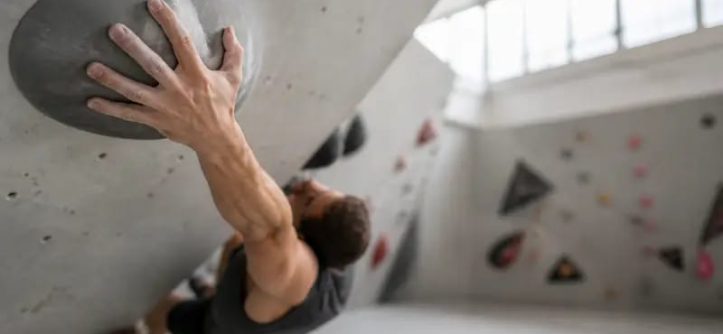
Slopers can be a real problem hold for climbers of all abilities, often causing more trouble for good climbers on crimps and jugs. Slopers have no edge to grab or place to put your fingers and so counterintuitive techniques must be used to hold them.
What Makes a Sloper Different
A jug has a lip on which to place your fingers. A crimp is a small ledge on which to place your fingers. A sloper is a smooth round surface on which to place as much of your hand as possible in order to gain as much friction as possible. The amount of force that a sloper will take before it starts to slip will depend on the angle at which you are pulling on it and the amount of friction that your hand has with the hold. Therefore, it is very important to use your body to position yourself on the sloper in order to gain as much friction as possible.
Get As Much Skin On As Possible
Press as much skin onto the hold as possible. By covering the hold with your whole hand (including your palm), as much skin as possible will be in contact with the surface of the hold. Spread your fingers on the hold as much as possible, rather than curling them up into a tight fist. Try to get a feel for the texture of the hold before placing any weight on it. The more skin in contact with the hold, the more friction there is between your skin and the surface of the hold. The more friction there is between your skin and the surface of the hold, the more hold there is.
Keep Your Hips Under The Hold
One of the biggest errors that new climbers make with slopers is to allow their hips to swing away from the wall. The weight of the climber then pulls the sloper in the one direction that it cannot withstand – outward from the wall. Keeping your hips close to the wall and directly underneath the hold in question will ensure that your weight is pushing downward onto the surface of the hold. This is how you ‘stack’ your body on slopers – down a line from your heels to your head in a straight line, or as close to it as is possible.
Straighten Your Arms
A sloper doesn’t work if you bend your elbow and pull with your arm as you would for a crimp. In this case your body weight will pull away from the wall and you’ll be reducing the downward pressure on the sloper. This can be one of the hardest things to learn and once you’ve been doing it for a while it can be just as hard to unlearn. Try to keep your arm as straight as possible and use your shoulder and core to hold your position on the sloper.
Push Through Your Legs
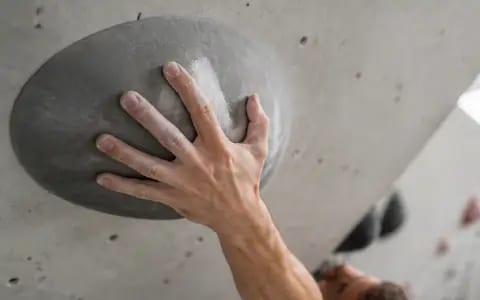
In trying to support your weight on a sloper, your hand can be doing far too much work. The best way to ensure that your hands are not having to work too hard is to use your feet and legs to push up into the sloper. If you find yourself yanking with your arms in order to reach a certain hand hold, you need to re-examine your foot placement. Body position and leg drive are paramount in a climber’s quest to master a sloper.
Go Easy On The Chalk
Slopers can also be negatively affected by chalk, especially on very smooth holds or those that receive a lot of use. A dry layer of chalk can actually decrease the amount of friction a sloper has to hold you. A light dusting is generally sufficient to prevent moisture from your palms and fingers to ensure a good grip. Most indoor centres maintain their holds in accordance with the surface maintenance policy of the relevant standards for UK climbing walls.
Practise With Traverses And Hangs
Low level traversing of a sloper covered wall with slow movement between holds is an excellent way to practice sloper use. Also practice hanging from slopers for short periods of time to get a feel for the angle of a hold before using it. More on Bouldering can be found at 270 Climbing.
Know When To Let Go
Slopers can fail in a subtle manner and it’s often the case that the point at which the hold begins to slip is the point at which you should let it go. Attempting to ‘hold on’ will only result in falling later, in a worse position. Remember, falling early in a controlled manner is generally better than falling later whilst in an unfortunate position.
Slopers are great for practising good positioning and controlling your fall. Try to use your hips to get under the hold, and check your arm angle too. Remember that it’s not your grip that’s letting you down!



Leave a Reply