
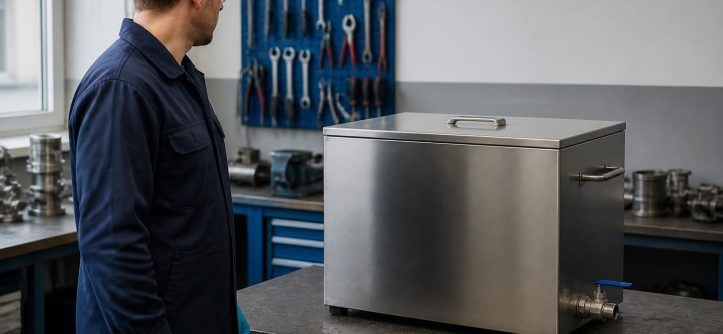
There is nothing worse than cleaning out grease and grime quickly, only to have problems with a large tank of water, with high amounts of power and chemicals being used to clean the parts.
Keep hands out while it’s running
Remember at all times to keep your hands out of the tank whilst in operation, even if only for a few seconds severe pain, numbness and possible permanent tissue damage can occur. Switch off the unit and allow the cleaning solution to settle prior to removal of parts.
Wear the right gloves and eye protection
Chemical resistant gloves and eye protection must be worn when using strong detergents and degreasers in a large ultrasonic cleaner. There is a large amount of literature available on the health effects of strong cleaning chemicals and skin protection, the HSE’s guidance on protecting skin from workplace chemicals is a good starting point and can help you choose the correct glove for the solution you are using. Remember to wash any splashes off your skin as soon as possible.
Always fit the lid during a cycle
There is also a risk of noise, fumes and fine mist escaping from the tank when it is in operation. This is further exacerbated by the larger volume of liquid in a large tank and the greater surface area of the liquid. Fitting a lid to the tank will contain all of the ultrasonic noise, fumes and fine mist given off by the tank and will also reduce the amount of noise heard in the surrounding area. There is more on Large Ultrasonic Cleaner at https://www.hilsonic.co.uk/.
Check the electrics before you fill up
In terms of power supply, this needs to be a RCD-protected circuit and should be positioned well away from the tank together with any leads, plugs and sockets. Be careful to check that cables etc. are not to be left in puddles of solution on the floor. For decontaminating reusable medical or dental instruments, a large ultrasonic cleaner is often used. MHRA guidance on decontaminating reusable medical devices outlines the necessary safety and cleaning steps to be taken and it is crucial that a proper and safe supply is provided to avoid any risks to users.
Let a fresh fill degas first
The solution will also hold air which will, in time, come out of solution as it is used, but in the interim, it will cease to clean effectively. It’s therefore very important to allow a fresh fill to degas for a few minutes before using it and to always fill to the recommended level to prevent solution splashing about when the cleaner is powered up.
Drain it carefully once it’s cooled
A full-size ultrasonic cleaner is very heavy after a clean and tends to be very hot. So it is best to use the built-in drain valve rather than attempt to tip/slide the cleaner and run the liquid near the cleaners’ electrics. Allow the solution to cool first.
The things you need to do to safely use your large ultrasonic cleaner again and again will be listed below.


Leave a Reply