
Bosch GWS8-45: The Most Affordable High-Performing Angle Grinder?
December 28, 2025
Camping Essentials: TECEUM 5/32 Paracord Rope 1000 Review
December 31, 2025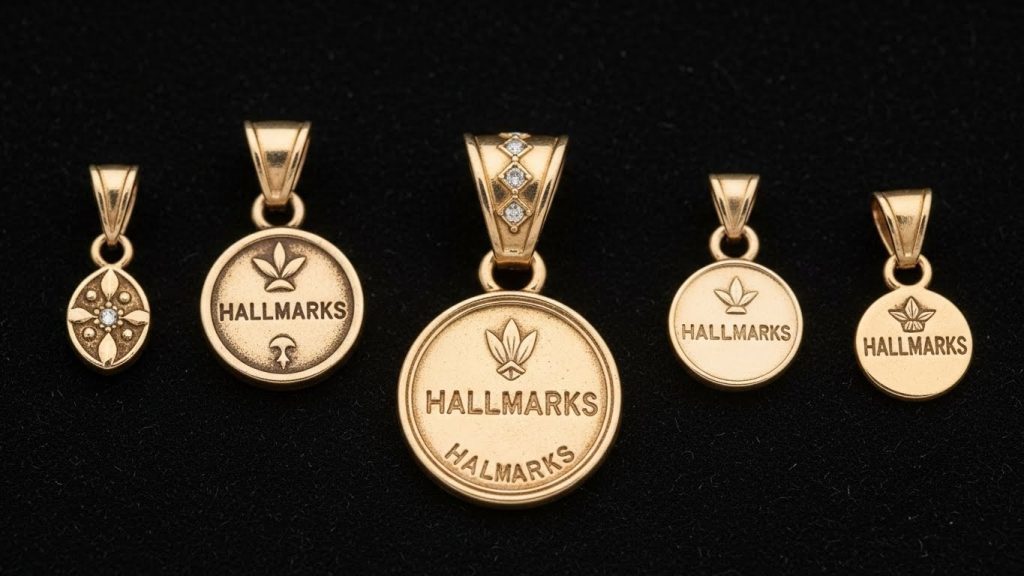
Ever stumbled upon tiny symbols carved into your rings, bracelets, or necklaces and wondered what they mean? Those little marks aren’t just random etchings—they’re jewellery hallmarks. Understanding how to read jewellery hallmarks is an essential skill for collectors, investors, and anyone who wants to verify the authenticity and value of their pieces.
Simply put, a jewellery hallmark is an official stamp indicating the metal’s purity, origin, and maker. They help you distinguish real gold or silver from plated or fake items. Learning to identify jewellery hallmarks can prevent costly mistakes, build your confidence as a collector, and enhance your appreciation for fine craftsmanship.
In this guide, you’ll find a step‑by‑step hallmark guide designed for new collectors, complete with examples, interpretation tips, and answers to common hallmark questions. Let’s decode these mysterious symbols together.
How Can You Start Reading Jewellery Hallmarks Like a Pro?
Before diving into specific examples, it’s important to understand that every hallmark tells a story about the jewellery’s composition and history. The hallmark usually contains several components:
- Metal type and purity mark (e.g., 925 for sterling silver, 375 for 9ct gold)
- Assay office mark (where the metal was tested and verified)
- Maker’s mark (the signature or initials of the manufacturer)
- Date letter or symbol (representing the year of certification)
Let’s break these down into simple, actionable steps.
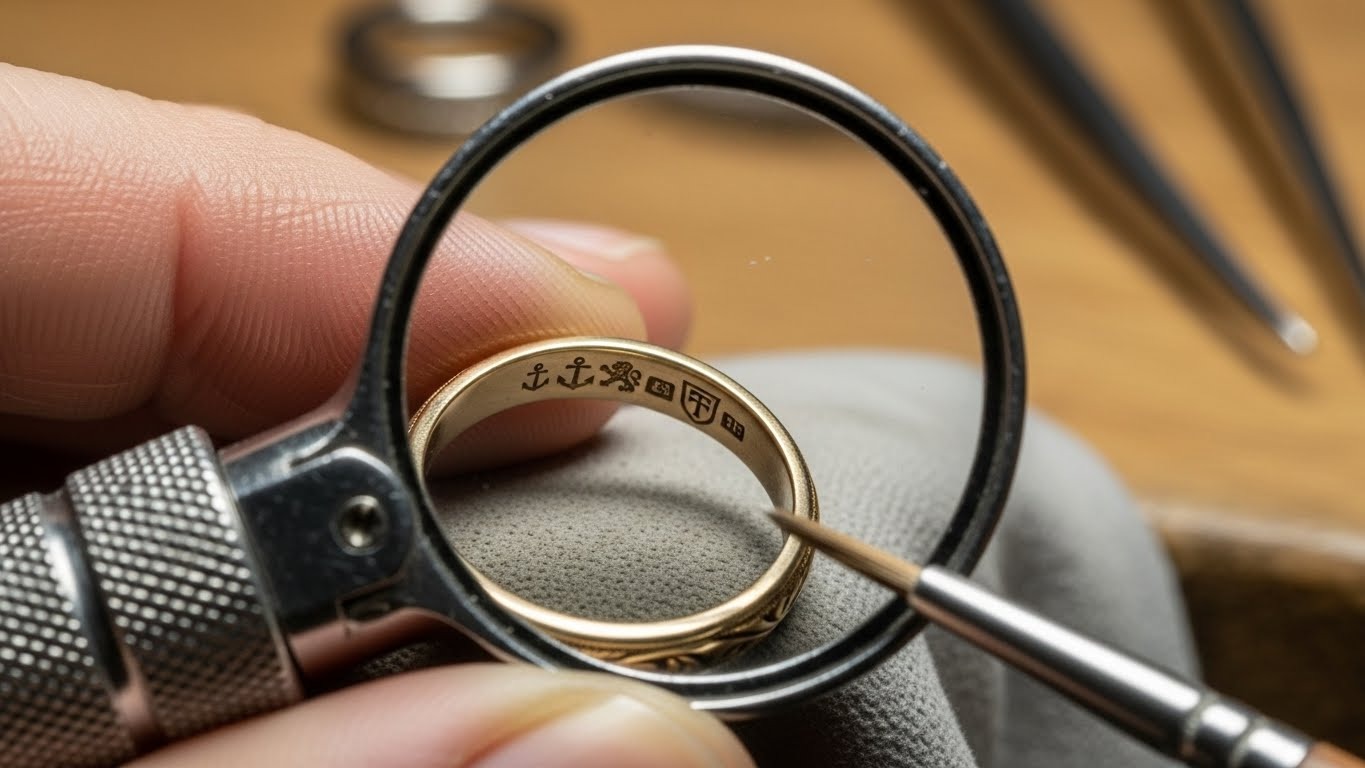
Step 1: Identify the Metal Type and Purity Mark
The first symbol you should look for is the quality or purity stamp. It tells you what metal your jewellery is made from and how pure it is. Here’s a quick reference table for common metals:
| Metal | Common Hallmark Numbers | Meaning |
|---|---|---|
| Gold | 375, 585, 750, 916, 999 | Indicates carat purity (9k, 14k, 18k, 22k, 24k) |
| Silver | 800, 925, 958, 999 | Refers to silver parts per thousand (sterling = 925) |
| Platinum | 850, 900, 950, 999 | Shows platinum purity, often with the letters “PLAT” |
| Palladium | 500, 950 | Modern metal used in fine jewellery |
Example: If your ring says “18K” or “750,” it means the gold content is 75% pure — a standard for high‑quality fine jewellery.
Step 2: Recognize the Assay Office Mark
The assay office verifies precious metals for purity and stamps them with an official mark. Each office has its own unique emblem. For instance:
- London – A leopard’s head
- Birmingham – An anchor
- Sheffield – A rose
- Edinburgh – A castle
- Dublin – A crowned harp
These marks identify where the item was tested and authenticated, which helps trace its origin.
Step 3: Decipher the Maker’s Mark
This is often an initial or logo stamped by the jeweller or manufacturer. The maker’s mark is legally required in countries like the UK, ensuring that each piece can be traced back to its creator.
For example, a hallmark reading “SG Ltd” might belong to SilverGuild London. You can look up maker’s marks in official databases or trade directories to learn more about the jewellery’s background.
Step 4: Understand the Date Letter or Symbol
Many hallmarks include a date letter that corresponds to a specific year. The letter style and font often change annually, adding another layer of identification.
For instance, the letter “q” in a square cartouche might signify 1990, while “r” in an oval might represent 1991, depending on the assay office. You can refer to online hallmark charts to match letters with their respective years.
Step 5: Examine Additional Marks or Symbols
Some items also feature optional hallmarks such as:
- Import marks – Indicating foreign-made items approved for sale in your country.
- Commemorative marks – Issued for special events (like royal anniversaries).
- Quality assurance stamps – Used by luxury brands for added credibility.
Where Can You Find Hallmarks on Jewellery?
Hallmarks are usually placed on discreet but reachable parts of the jewellery to avoid affecting its aesthetic. For example:
- Inside ring bands
- On necklace clasps
- Back of pendants
- Edge of bracelets
- Inside watch cases or backs
Use a magnifying glass or a jeweller’s loupe to inspect them clearly. The marks may be tiny, especially on delicate vintage pieces.
How to Identify Fake or Misleading Jewellery Hallmarks?
In the modern market, fake hallmarks are a growing issue. To protect yourself, follow these verification tips:
- Look for crisp and even stamping — genuine hallmarks are neat and consistent.
- Be wary of stamps like “18K GP” or “925 plated.” The “GP” means gold plated, not solid gold.
- Check the hallmark’s position. If it looks crudely etched or misplaced, it might be counterfeit.
- Use an acid test or digital analyser to verify metal type.
- When in doubt, consult a certified jeweller or appraiser.
What If the Jewellery Has No Hallmark?
Older or handmade jewellery might not always carry stamps, especially pieces made before hallmarking became mandatory. In such cases:
- Visit an appraisal service for independent testing.
- Check for brand documentation or old bills of sale.
- Assess metal tone and weight as secondary authenticity indicators.
Modern jewellery sold in reputable stores should always have hallmarks. Lack of them is a red flag in most cases.
Why Is Learning How to Read Jewellery Hallmarks Important?
Knowing how to read jewellery hallmarks empowers you to:
- Prevent overpaying for low-quality or fake metals
- Understand the history and heritage of a piece
- Buy and sell jewellery with confidence
- Protect your investment portfolio
For collectors, identifying jewellery hallmarks is as exciting as uncovering hidden stories. Each tiny symbol adds historical, emotional, and financial value.
Can Hallmarks Increase Jewellery Value?
Yes. Hallmarks are often proof of a jewellery item’s authenticity and origin, which boosts trust and resale value. Items stamped with marks from prestigious assay offices or renowned makers can command premium prices at auctions.
For collectors or investors, hallmark knowledge is a competitive edge in determining which pieces are rare, genuine, or undervalued.
Conclusion: What’s the Next Step for New Collectors?
Learning to read jewellery hallmarks can transform how you view every ring, necklace, or bracelet. With practice, you’ll recognize the symbols at a glance and appreciate the craftsmanship behind each piece. Whether you’re collecting vintage treasures or investing in modern designs, hallmark reading gives you control, confidence, and deeper insight into your collection.
Ready to start your hallmark journey? Grab a magnifying glass, explore your collection, and decode your first hallmark today. The more you study these marks, the more skilled you’ll become at identifying jewellery hallmarks like a pro.
For more guides on jewellery care, buying tips, and valuation techniques, subscribe to our newsletter and get expert advice delivered to your inbox.
Frequently Asked Questions (FAQs)
What does 925 mean on jewellery?
925 indicates sterling silver — 92.5% pure silver mixed with 7.5% other metals for strength and durability.
Is 18K gold better than 14K?
Yes, 18K gold is purer (75% gold) than 14K (58.5% gold). However, 14K is more durable for daily wear.
How can I tell if a hallmark is real?
Genuine hallmarks are crisp, uniform, and often accompanied by an assay office mark. Avoid jewellery with etched or uneven marks.
Can fake jewellery have hallmarks?
Unfortunately, yes. Counterfeiters sometimes stamp fake hallmarks to mislead buyers. Always buy from trusted jewellers.
Do antique pieces always have hallmarks?
No. Some older pieces predate hallmarking laws. When in doubt, get them verified by a professional appraiser.
Where should I look for hallmarks?
Inside rings, necklace clasps, bracelet edges, or pendant backs are common hallmark spots.
Can I sell unhallmarked jewellery?
Yes, but you’ll need an independent metal test certificate to confirm authenticity before selling.
Related Topics: Bosch GWS8-45: The Most Affordable High-Performing Angle Grinder?
Related Topics: How to Choose a High-Quality Diamond Ring